CSI Simulation: Why Additive Noise Fails and How to Fix It
A. Bouferroum, I. Alla, V. Lenders, V. Loscri
MSWiM 2026 · Paris, France Accepted
Wi-Fi sensing models are usually trained on noise-simulated data. We show why that breaks inside real receivers, and how to fix it…
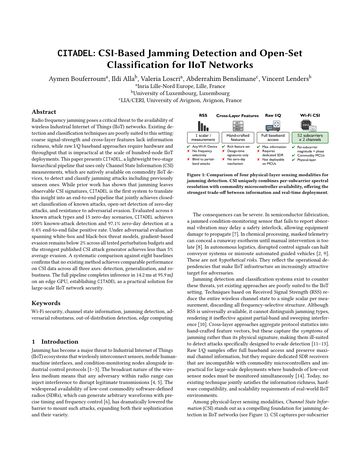
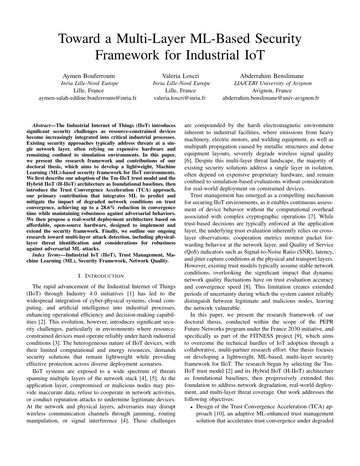
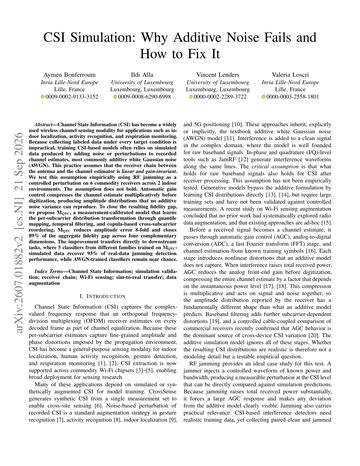
Most Wi-Fi sensing models are trained on simulated data built by adding noise to recorded channel estimates. We tested that assumption on six commodity receivers and found it breaks: the receiver's automatic gain control compresses the signal in ways no additive noise can reproduce. Our answer is MQTC, a measurement-calibrated model combining quantile mapping, temporal filtering, and copula-based reordering, which cuts amplitude error 8-fold and closes 89% of the fidelity gap. Classifiers trained on MQTC data recover 93% of real-world jamming-detection performance, while noise-trained ones remain near random.
@inproceedings{bouferroum2026csisimulation,
  title={CSI Simulation: Why Additive Noise Fails and How to Fix It},
  author={Bouferroum, Aymen and Alla, Ildi and Lenders, Vincent and Loscri, Valeria},
  booktitle={28th International Conference on Modeling, Analysis and Simulation of Wireless and Mobile Systems (MSWiM)},
  address={Paris, France},
  publisher={IEEE},
  year={2026},
  note={To appear}
}